




01
Describe or Upload
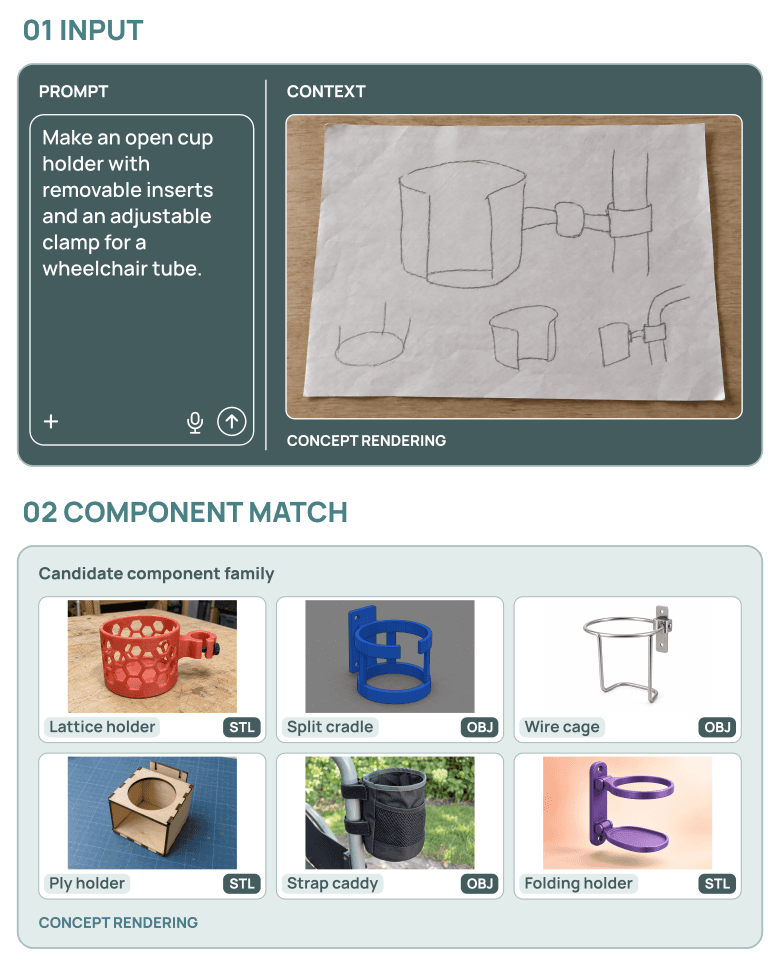
Begin with one input or combine several references in the same project. Mendr AI is designed to interpret the intended function, physical requirements, existing equipment, and available dimensions.
Coming in 2027
Mendr AI is an AI prototyping tool designed to help disabled individuals turn prompts and reference files into preliminary 3D assemblies, component files, and fabrication information that can move into professional review and prototyping.
Describe or upload a need through any combination of text, voice, drawings, photographs of a person or device, 2D CAD, 3D CAD, or existing 3D models.
01
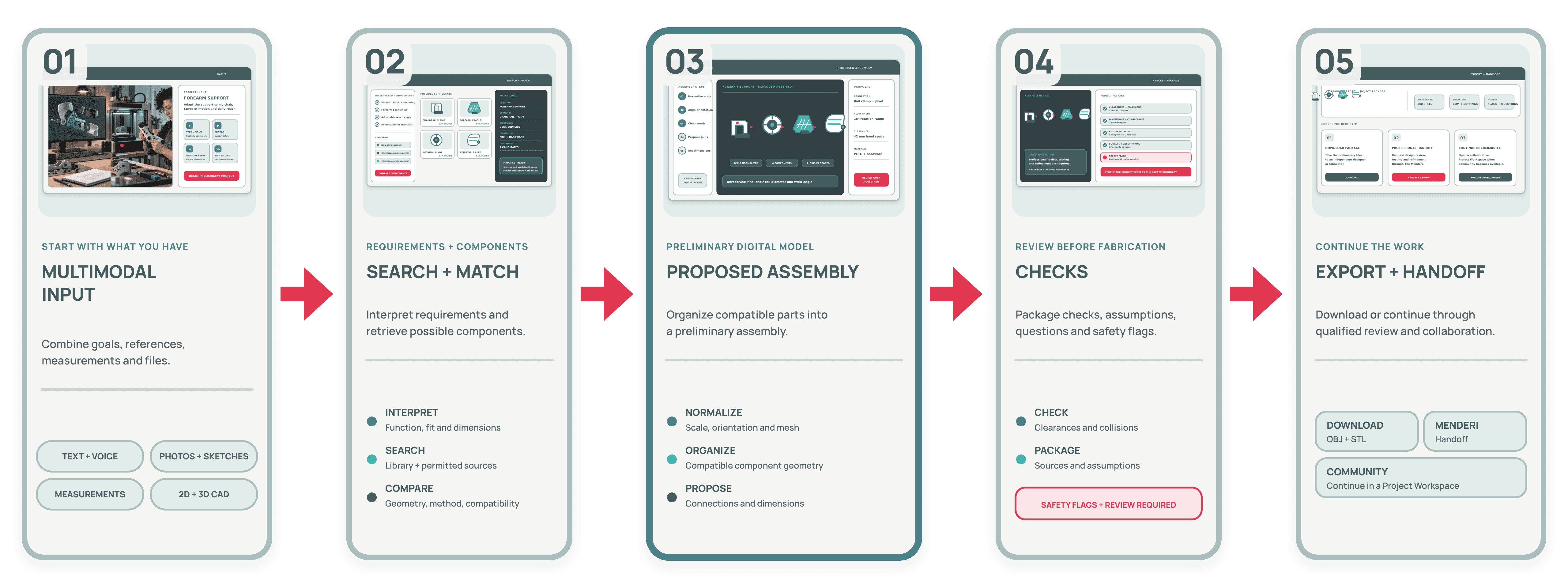
Begin with one input or combine several references in the same project. Mendr AI is designed to interpret the intended function, physical requirements, existing equipment, and available dimensions.
02
Mendr AI will search the Open Device Library and available online sources for parts, geometries, and existing models that may fit the project. It will compare available components by function, geometry, dimensions, fabrication method, and compatibility with the developing assembly.
03
The planned geometry pipeline will normalize scale and orientation, perform basic mesh cleanup, flag incomplete or non-manifold geometry, and organize compatible parts into a multi-part assembly. Mendr AI will propose connections and preliminary dimensions, analyze intersections and clearances, run collision checks, and identify unresolved design questions. More advanced automated mesh repair will follow in later development.
04
Mendr AI will compile the proposed assembly, component files, fabrication information, sources, assumptions, and safety flags into one project package. Users will be able to download the package for an independent designer or fabricator, request professional handoff through The Menderi, or continue development through Menderi Community.
An interactive 3D concept and multi-part assembly
Separate component files and proposed connections
Preliminary dimensions and clearances
A bill of materials, vendor links, source links, and license information
Fabrication suggestions, material guidance, and print settings where available
Design assumptions, unresolved questions, and safety flags
Initial exports are planned in OBJ and STL formats. STEP and additional formats will follow in later development.
Mendr AI is designed to shorten the path from an unmet need to a working digital starting point. Its outputs can give designers and fabricators a clearer foundation for technical review, refinement, testing, and fabrication.
Projects will be public by default. Before download, users will see what will be published to the Open Device Library and which source licenses apply. Users retain ownership of their original contributions.
Mendr AI will generate preliminary design information, not finished or certified devices. Every output requires appropriate review, testing, and refinement before use.
Implantable devices
Life-sustaining equipment
Person-lifting systems
Load-bearing mobility devices
Pediatric devices