Current Pilot

Disability-Led Design

The Menderi works with disabled individuals through research, design, fabrication, testing, and refinement. Participants define the need, shape each decision, and learn the tools behind the build.

10

person pilot

person pilot

2

prototype iterations per project

prototype iterations per project

30 / 90

day follow-up

day follow-up

PILOT AVAILABILITY

A few places remain in the 10‑person pilot

OUR PROCESS
From Lived Need to Working Device

From Lived Need to Working Device

From Lived Need to Working Device

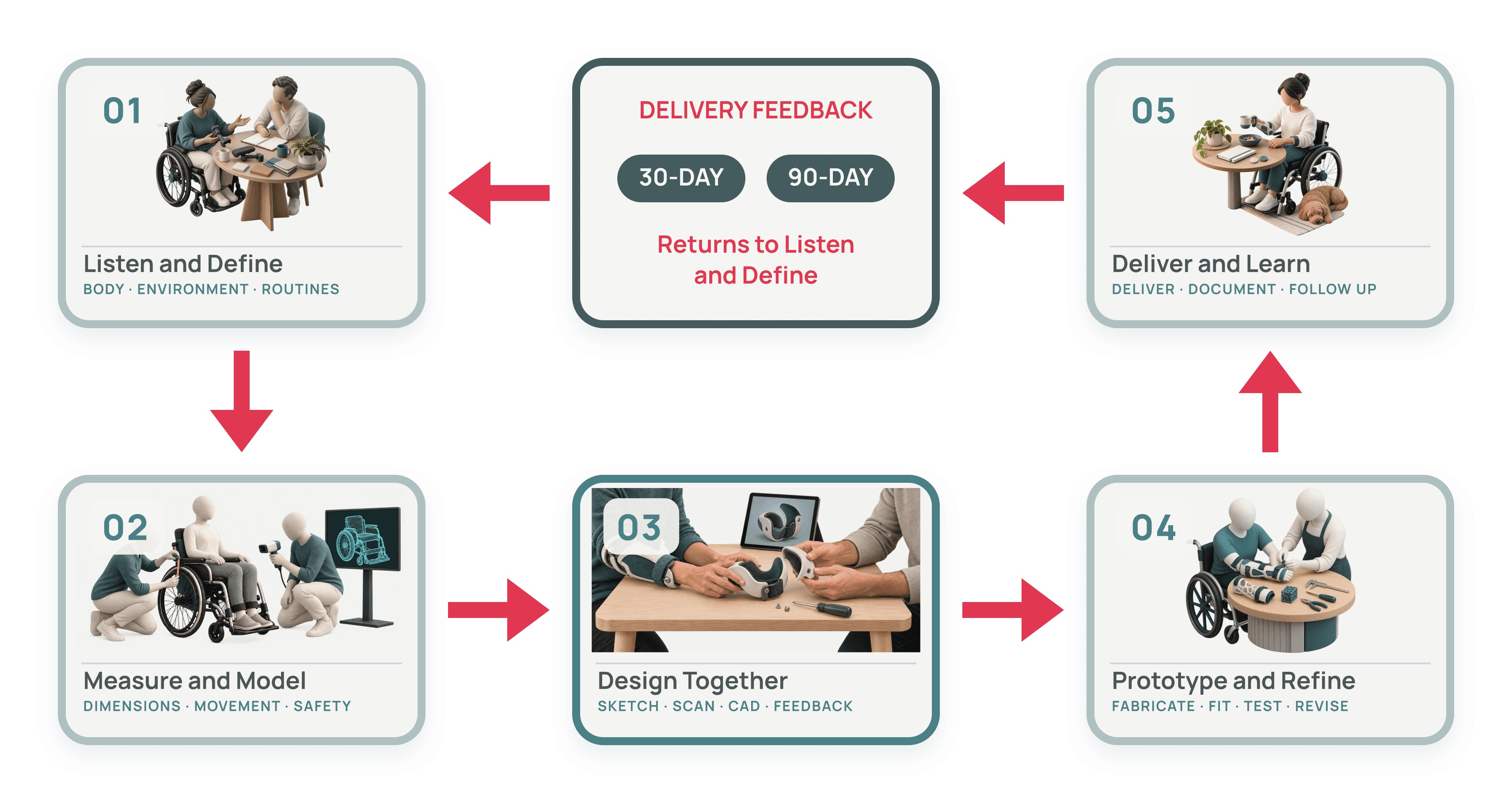
Five-stage participant-led process: Listen and Define, Measure and Model, Design Together, Prototype and Refine, and Deliver and Learn, with feedback after 30 and 90 days returning to the start.

STEP 01

Listen and Define

Begin with the individual’s body, environment, routines, priorities, and existing equipment.

STEP 02

Measure and Model

Translate lived experience into dimensions, movements, attachment points, materials, fabrication requirements, and safety considerations.

STEP 03

Design Together

Use sketches, scanning, CAD, physical samples, and participant feedback to develop a shared direction.

STEP 04

Prototype and Refine

Fabricate, fit, test, and revise through two participant-led iterations. The first prototype is part of the conversation, not a finished answer. Clinical or technical review is included when appropriate.

STEP 05

Deliver and Learn

Complete the device, document the build, and gather feedback after 30 and 90 days. Each accepted project is supported through the full cycle.

DEVICES IN DEVELOPMENT

Built Around the Individual

Built Around the Individual

Built Around the Individual

The following concepts are in development. Renderings show intended design directions, not completed devices.

Prototype in development

Prototype in development

Design visualization

Prototype in development

Design visualization

Adaptive Ergonomic Support with the Pellet Pouch

Adaptive Ergonomic Support with the Pellet Pouch

Adaptive Ergonomic Support with the Pellet Pouch

A resettable cushion would use interconnected silicone cells, foam pellets, a hand pump, and removable pads to form support around the body, then reshape it as needs change.

Challenge

A wheelchair user needs pressure support that can change as posture and pain shift throughout the day.

Proposed Device

A resettable cushion would use interconnected silicone cells, foam pellets, a hand pump, and removable pads to form support around the body, then reshape it as needs change.

Potential Difference

Adaptable positioning without replacing the entire cushion each time support needs change.

Pellet Pouch Adaptive Cushion design visualization: shaping a filled pouch into fitted support, the silicone-cell internals, the cushion and pump kit with removable foam pads, and lumbar and neck support applications. Prototype in development.

Prototype in development

Design visualization

AUGMENTATIVE CLOTHING

Dynamic Gait Control (DGC) Wearable

Dynamic Gait Control (DGC) Wearable

Dynamic Gait Control (DGC) Wearable

Challenge

A child with impaired motor signaling needs clearer feedback about the position and movement of their hips, knees, and ankles during gait training.

CURRENT SETUP

Physical therapy and available orthopedic systems do not provide a lightweight, adaptable way to analyze movement and deliver immediate physical cues throughout the gait cycle.

CO-DESIGNED DIRECTION

The Dynamic Gait Control (DGC) Wearable combines technologies adapted from professional VFX motion-capture suits with electronically controlled auxetic mechanisms and electrostimulation to create responsive augmentative clothing. An accelerometer sensor array embedded throughout the garment records the user’s gait, allowing the system to learn from individual movement patterns and introduce incremental corrections toward improved alignment. At precisely timed moments in the gait cycle, electrostimulation pads and auxetic zones vibrate, expand, and contract to cue when and how strongly specific muscles should activate. Together, these technologies are intended to help train and optimize gait by functioning as an external motor-control center for a user with impaired motor signaling.

PRACTICAL DIFFERENCE

More responsive and repeatable gait practice in a device designed to adapt as the body grows.

WEARABLE · THREE VIEWS

Dynamic Gait Control Wearable prototype in development: front, perspective, and side views of child-sized augmentative clothing combining motion sensors, textile electrodes, and auxetic zones.

01 · GAIT SYSTEM

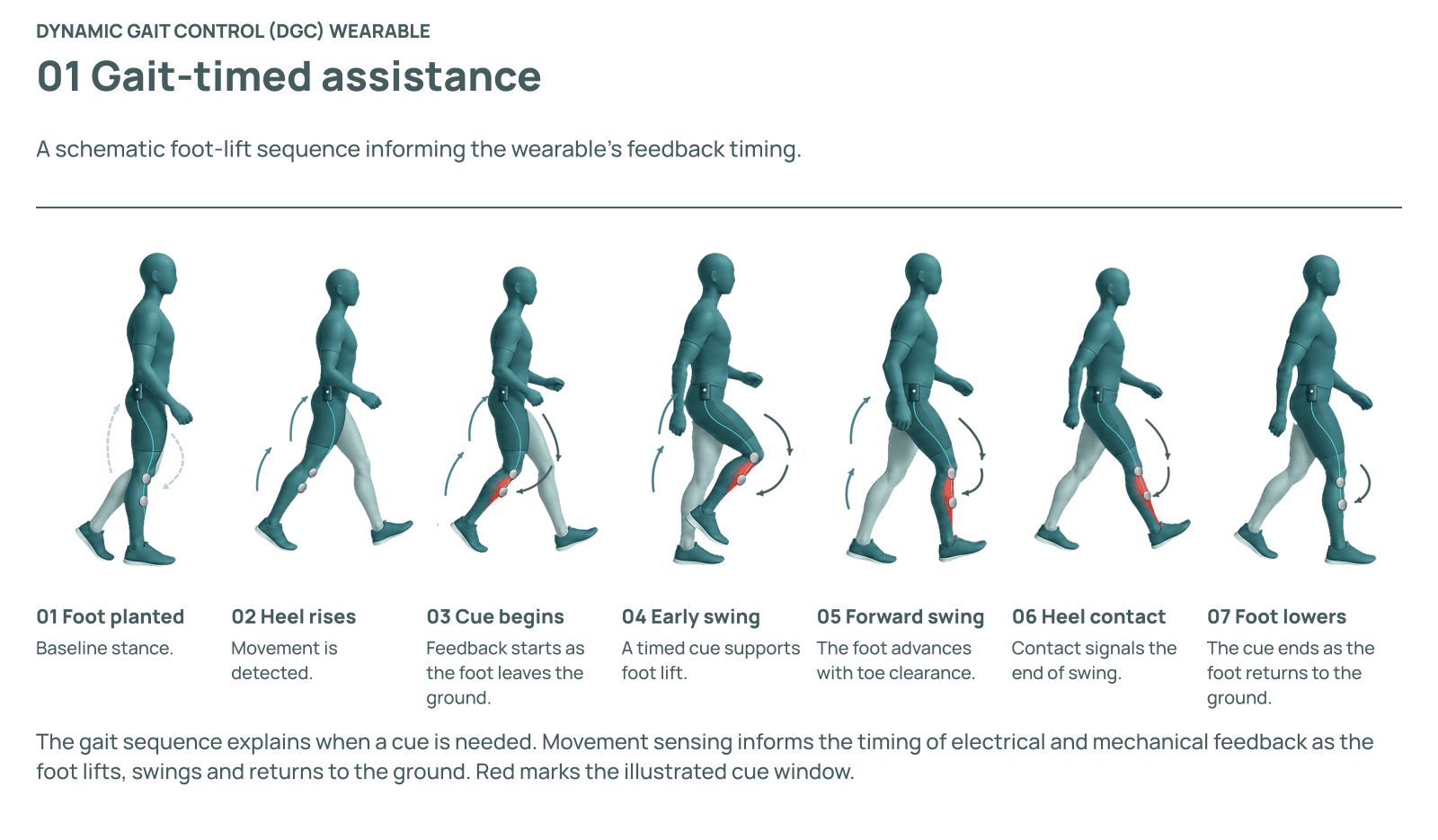
Seven-stage gait-timed assistance sequence from foot planted through heel rise, cue onset, early swing, forward swing, heel contact, and foot lowering. Red marks indicate the illustrated cue window.

02 · MOTION CAPTURE

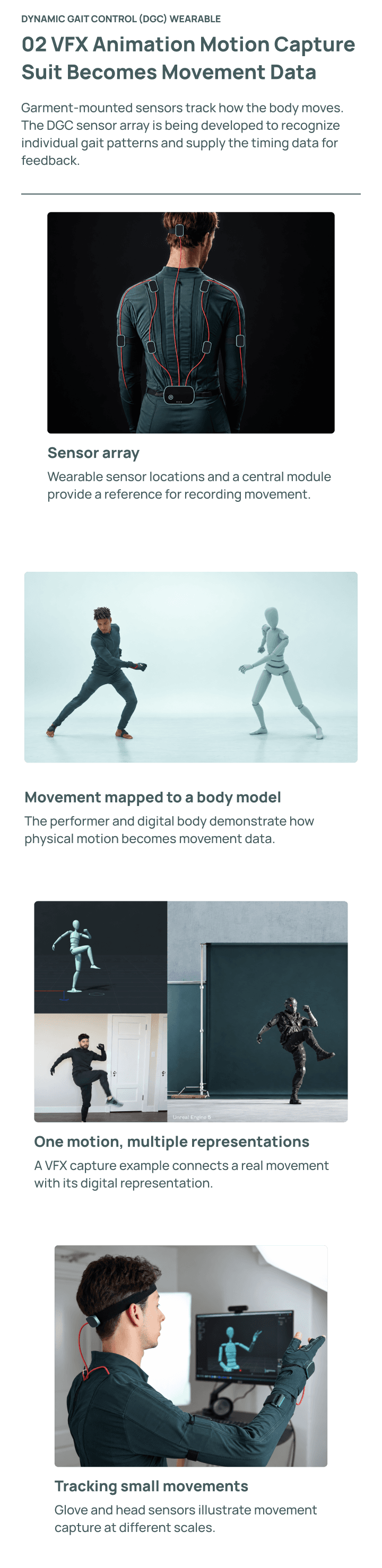
Motion-capture references show a garment-mounted sensor array, movement mapped to a body model, VFX motion representations, and sensors for tracking smaller movements.

03 · ELECTROSTIMULATION

Electrostimulation design visualization illustrating electrical cues woven into clothing, textile electrodes, conductive paths, and flexible support references.

04 · AUXETIC STRUCTURES

Auxetic structures design visualization for responsive augmentative clothing, showing mechanisms and material structures intended to expand and contract to provide physical cues.

Prototype in development

Design visualization

HEMI-WALKER SIT-TO-STAND SUPPORT

A Safer Path From Sitting to Standing

A Safer Path From Sitting to Standing

A Safer Path From Sitting to Standing

CHALLENGE

A wheelchair user with one functional arm cannot safely rise into or use a conventional hemi walker without physical assistance.

CURRENT SETUP

The wheelchair provides seated mobility, while the standard hemi walker assumes enough balance and leg strength to stand before using it. The transition between them remains unsupported.

CO-DESIGNED DIRECTION

Mechanical adaptations to a standard hemi walker would add rigidity and stabilize the standing motion while preserving one-handed control. Prototyping would focus on the transfer sequence, support geometry, portability, and compatibility with the participant’s home.

PRACTICAL DIFFERENCE

A safer path toward standing and short-distance movement, with less lifting for caregivers.
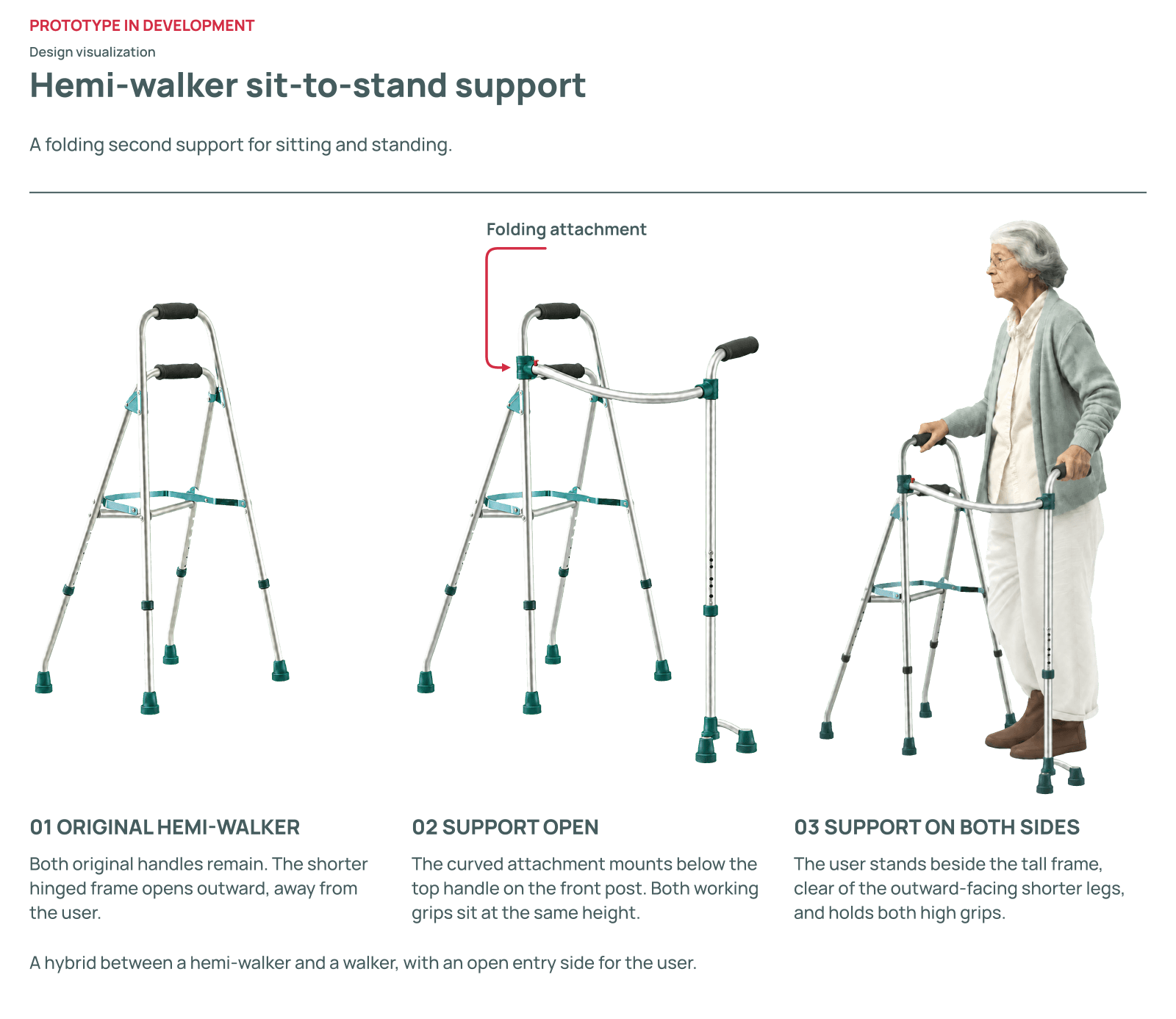
Hemi-walker sit-to-stand support design visualization: the original hemi-walker, the folding support open, and a user holding support on both sides. Prototype in development.

OPEN DOCUMENTATION

Built Once, Shared Further

With participant consent, successful projects will be documented as open fabrication packages. Depending on the build, these may include 3D models, print files and settings, parts lists, assembly instructions, toolpaths, license information, and safety documentation.

CONSENT + PRIVACY

Your Story Belongs to You

Participation never requires public disclosure of a diagnosis, identity, photograph, or personal story. Participants decide what may be shared, may participate anonymously, and can revisit consent. Open documentation can focus on the device without publishing personal information.

Get involved

Help Build What’s Missing

The Menderi brings disabled individuals, designers, fabricators, clinicians, community organizations, and technical partners together to develop better assistive technology. Join us by contributing your time, expertise, resources, or support.

Join the Menderi Newsletter

Get occasional updates on device builds, the Open Device Library, Mendr AI, and ways to participate.

Get involved

Help Build What’s Missing

The Menderi brings disabled individuals, designers, fabricators, clinicians, community organizations, and technical partners together to develop better assistive technology. Join us by contributing your time, expertise, resources, or support.

Join the Menderi Newsletter

Get occasional updates on device builds, the Open Device Library, Mendr AI, and ways to participate.

Get involved

Help Build What’s Missing

The Menderi brings disabled individuals, designers, fabricators, clinicians, community organizations, and technical partners together to develop better assistive technology. Join us by contributing your time, expertise, resources, or support.

Join the Menderi Newsletter

Get occasional updates on device builds, the Open Device Library, Mendr AI, and ways to participate.